10 Best Travel Games for Kids on Planes in 2026 (No Screens Needed)
Last March, crammed into seat 23B on a seven-hour flight to London, I watched my daughter's tablet hit 4% battery just as the pilot announced we were 27th in the takeoff queue. The charger port was dead. Her face crumpled. I fumbled through my carry-on and pulled out a crumpled pack of travel bingo cards I'd almost left on the kitchen counter. She sighed, rolled her eyes, and ten minutes later she was gleefully smearing a cereal-piece marker across "cloud shaped like a dinosaur." That moment crystallized something I'd been learning for years: the best travel games for kids on planes aren't the ones that need pixels. They're the ones that fit in a seat-back pocket, survive a juice spill, and don't care whether the in-seat USB actually works. In 2026, when even toddlers know how to swipe, parents are rediscovering a counterintuitive truth—screen-free plane games for kids often hold attention longer than apps do, because they engage hands, voices, and that weird little gap between the window shade and the fuselage. This isn't a Luddite manifesto. It's a battle-tested list of games that have actually worked on actual flights, no charging cable required.
1. Magnetic Travel Board Games: Classic Fun That Stays Put
If I had to pick one category that saves more flights than any other, it's magnetic travel board games. The physics are simple and beautiful: metal boards plus magnet-bottom pieces equal nothing rolling under seat 24C. I've watched a four-year-old play magnetic tic-tac-toe through twenty minutes of turbulence without losing a single X. In 2026, you can find compact sets that fold into a book-sized case and include chess, checkers, snakes and ladders, and Chinese checkers all in one. The brand Magnetic Travel Fun makes a slim tin that fits in a diaper bag's outer pocket and costs less than a airport sandwich. One specific hack I've adopted: bring a small magnetic whiteboard and a handful of letter magnets. Kids can spell words, make silly sentences, or just rearrange the alphabet while you drink a coffee that's still warm. For older kids, a magnetic chess set with a storage drawer means you can pause mid-game when the drink cart arrives and resume without resetting. The key is the "no lost pieces" factor—every parent knows that crawling on an airplane floor looking for a tiny pawn is a special circle of travel hell. Magnetic games eliminate that entirely.
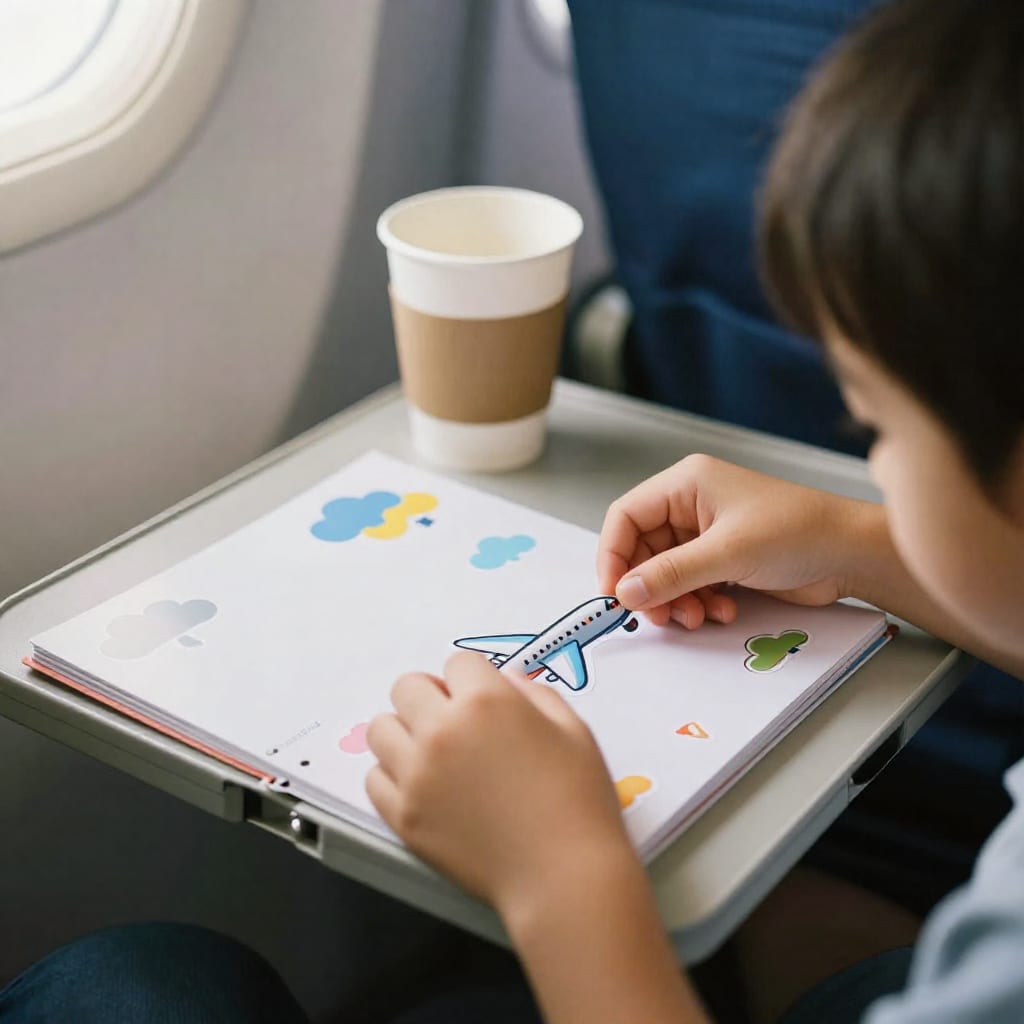
2. Reusable Sticker Pads: Quiet Creativity with Zero Mess
Reusable sticker books have quietly become the MVP of quiet sticker activities for kids on planes. Unlike the old paper stickers that peel once and then curl into sad little crescents on the seat upholstery, the new generation uses cling-style or low-tack adhesive that works on glossy background scenes. My niece spent a full hour repositioning jungle animals on a savanna scene, narrating a drama about a giraffe who wouldn't share the waterhole. The best sets in 2026 are themed—airports, outer space, under the sea, construction sites—and fold flat. Look for ones labeled "reusable" and "static cling" rather than traditional adhesive. A pro move: bring two different themed books and swap them halfway through the flight; the novelty reset works like a charm. For toddlers specifically, the peeling-and-placing motion is a fine-motor workout that keeps little hands busy, and there's zero mess to clean up when the fasten-seatbelt sign dings. I've also started packing a slim plastic envelope to store loose sticker sheets so they don't get crumpled in the seat pocket.
3. Travel-Sized Card Games: Portable and Packable Favorites
A deck of cards weighs nothing and can generate a dozen different games, but in 2026 the travel card games for kids market has gotten smarter. I carry a tin of Spot It! in its mini camping edition—a round deck that fits in a palm and a game that takes thirty seconds to explain. On a flight to Denver last year, my daughter and I played seventeen rounds of Go Fish using a deck of animal cards the size of a matchbook, and the tray table had room to spare. Uno's travel version now comes in a hard plastic case that clips to a backpack strap. The newer compact card games for airplane trips include Taco Cat Goat Cheese Pizza in a pocket-sized edition, which had the row behind us laughing (yes, it's a loud game—use judgment). One underrated option: a simple deck of blank-face cards with a dry-erase marker. Kids can invent their own game, draw characters, or practice numbers. The beauty of card games on a plane is that they naturally involve other people—siblings, parents, a willing grandparent—so they double as social glue. I always pack at least two card games in different categories (one matching, one strategy) to rotate when attention flags.
4. DIY Scavenger Hunt Kits: Observational Play That Kills Time
An airplane scavenger hunt for kids is the cheapest high-engagement tool I know, and in 2026 it's easier to make than ever. I laminate a sheet with a grid of simple icons: a red suitcase, a person wearing headphones, a cloud shaped like a turtle, a flight attendant with a ponytail, the word "EXIT" in green. A dry-erase marker clips to the board with a string and a suction cup (trust me, the suction cup matters—it stops the marker from rolling away). My kids have spent entire flights staring out the window hunting for specific plane parts or ground features. Inside-the-cabin hunts work too: find someone reading a paper book, spot a baby wearing yellow socks, count how many people order tomato juice. For the 2026 twist, I now include a few QR-code-style square patterns in the corner of the laminated card that kids can "scan" with a pretend wristband—it sounds absurd, but the role-play element extends interest dramatically. Observation games for travel like this require no pieces, no battery, and they adapt to any age by making the targets harder or easier. Toddlers can hunt for colors; tweens can hunt for specific airplane models out the window.
5. Travel-Sized Puzzle Books and Wipe-Clean Activity Sets
The wipe-clean activity books for planes that exist now are leagues better than the flimsy ones from five years ago. I use a spiral-bound set from Priddy Books that includes mazes, dot-to-dots, tracing, and simple math puzzles, all with a pen that stores in the spine and erases with a dry cloth. A single book has gotten us through three round-trip flights and still looks new. Travel puzzle books for kids that focus on mazes and word searches are also ideal for the 6-to-10-year-old crowd—the thin paper versions aren't reusable, but they're light enough to pack three. I tear out pages in advance and clip them to a small clipboard; the rigid surface makes writing on a tray table feel less like performing surgery. One specific recommendation: the Usborne Travel Activity Pad has a mix of puzzles, drawing prompts, and logic games that scale well across a long flight. The unsung advantage of puzzle books is that they're silent. No clicking, no beeping, no narrator voice drifting into the next seat. When the cabin lights dim and the screen-users start squinting, a kid with a headlamp and a maze book is in a little cone of contentment.
6. Mini Building Sets and Connector Toys: Hands-On Engineering
I was skeptical about mini building toys for travel until a friend handed my son a zip pouch of Plus-Plus pieces on a flight to Seattle. These are tiny, interlocking plastic shapes that fit together in a surprising number of ways, and the whole set weighed less than a deck of cards. He built a robot, a rocket, and something he called a "pizza tower" before we hit cruising altitude. The trick with connector toys for plane trips is containment. I now carry a shallow, flexible silicone tray (originally meant for pet food, no joke) that unfolds flat on the tray table and has slightly raised edges. Pieces stay inside, and the whole thing collapses and clips shut. LEGO's tiny DOTS or Mini-Figure series work too, but I've learned the hard way to count pieces aloud when packing and again when deplaning—missing a single translucent blue block triggers a level of grief disproportionate to its size. For younger builders, Squigz (suction-cup connectors) stick to the window or tray table and peel off cleanly. The key insight: building is a solo, immersive activity that doesn't require a parent's constant involvement, which is worth its weight in gold at 35,000 feet.
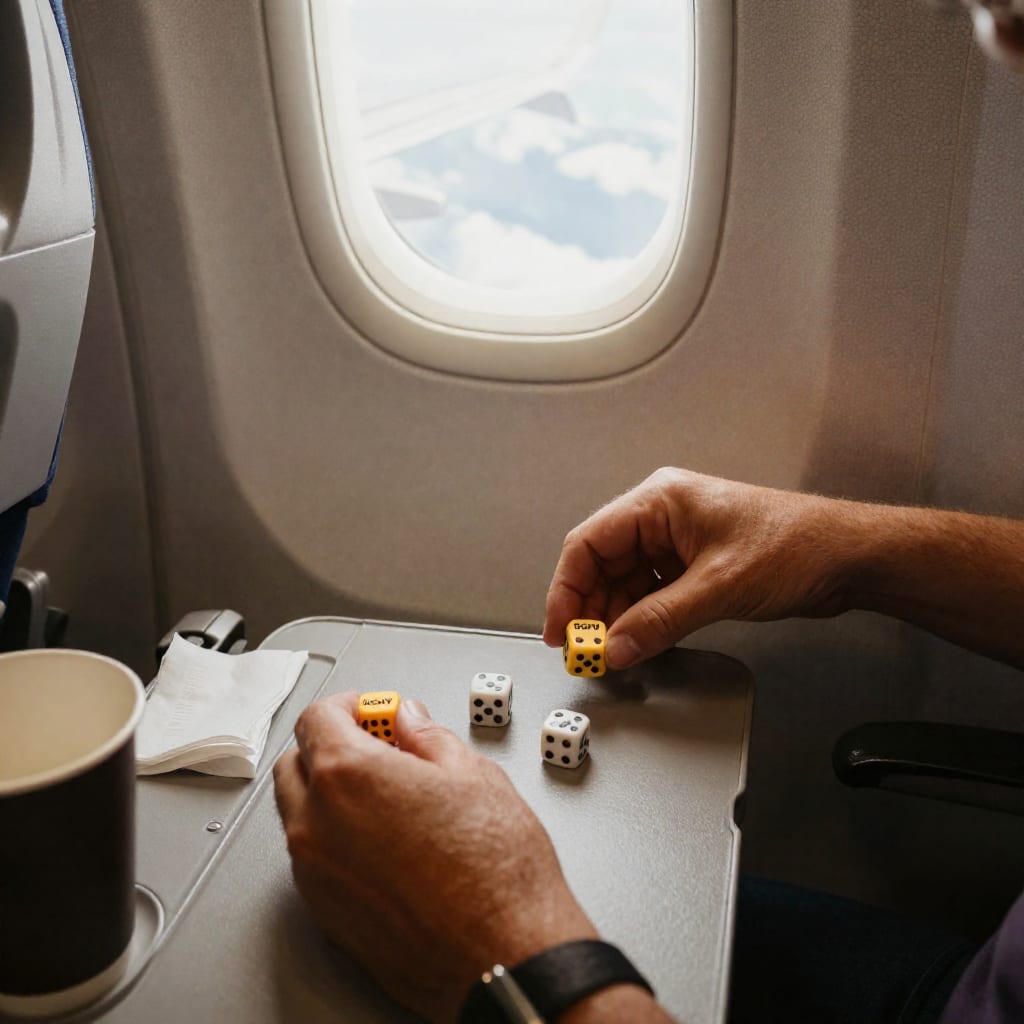
7. Storytelling Dice or Prompt Cards: Spark Imagination Together
Storytelling games for kids on planes have an almost magical ability to turn a cramped row into a tiny theater. I carry a set of Rory's Story Cubes—nine dice with simple pictures (a lightning bolt, a key, a turtle, a moon)—in a small cloth bag. One person rolls three dice and starts a story, the next person rolls and continues it, and it spirals from there. On a delayed flight to Chicago, my family co-created a thirty-minute epic about a turtle who stole a key to the moon, and the couple across the aisle started listening and laughing along. These creative travel games with no screens work across ages because a five-year-old can contribute a sentence and a twelve-year-old can add plot twists. If dice aren't your thing, a deck of storytelling prompt cards (like Tell Me a Story cards) works the same way: "A cat who works as a chef," "A treehouse that travels through time." I've also made my own by writing random words on index cards with a Sharpie. The social aspect is what makes these stick—when everyone's engaged in the same story, the flight stops feeling like endurance and starts feeling like family time. Pro tip: record the story on a phone voice memo so kids can listen later; it becomes a weird, treasured artifact.
8. Finger Puppets and Shadow Play: Tiny Theater in Your Seat
This category takes up literally no bag space, which is why I always forget to mention it and then remember when I'm desperate. Finger puppets for travel can be as simple as drawing faces on your own fingertips with a ballpoint pen. I've also packed a set of four tiny animal puppets from IKEA that weigh less than a granola bar and live permanently in my carry-on. For a toddler, a puppet asking "Are we there yet?" in a silly voice is inexplicably hilarious for twenty minutes straight. Shadow play games for kids on planes work best when the cabin lights are dimmed and you can use the overhead reading light to cast shadows on the tray table or seat back. A bird, a dog, a bunny—kids love guessing, then trying to make their own. One unexpected 2026 twist: a tiny keychain flashlight (the kind that costs $2 at a hardware store) turns shadow puppets into a full-on production. This isn't a three-hour solution, but it's brilliant for the last forty minutes of a flight when everything else has been exhausted and you need one more rabbit to pull out of the hat.
9. Audible Story Games (No Screen, Just Ears): The 2026 Twist
Screen-free doesn't have to mean silent. Audio games for kids on planes have evolved, and in 2026 there are genuinely clever options that don't involve a tablet display. We use a Yoto Mini—a tiny, durable audio player that plays story cards when you slot them in. No screen at all, just physical cards and a headphone jack. I pre-load it with interactive audio games like "Sound Detective" (guess the sound effect) and long-form stories with built-in prompts ("What do you think happens next? Pause and tell a grown-up"). A basic MP3 player loaded with podcasts from Brains On! or Story Pirates works too. The trick is to download everything the night before—I've made the 4 a.m. airport-WiFi mistake exactly once. For a DIY version, record yourself reading a favorite book with intentional mistakes ("And then the caterpillar ate four pickles—wait, is that right?") and let your child correct you. These screen-free listening activities for travel 2026 keep kids engaged while they stare out the window or doodle, and they don't contribute to the eye-strain headache that long screen sessions cause. A pair of volume-limited headphones completes the setup.
10. Travel Bingo: A Customizable Classic That Scales with Age
Travel bingo for kids is the game I've adapted more times than any other, and it's never failed. I print 4x4 grids on cardstock before a trip: for a three-year-old, the squares might show a truck, a cow, a red car, a bridge; for a nine-year-old, they might include a license plate from a specific state, a bird of prey, a water tower, a person wearing a hat. Cereal pieces (Cheerios or similar) make perfect, edible markers. On a plane, the bingo targets shift to cabin items: a blue suitcase, someone wearing a neck pillow, a flight attendant with glasses, the word "LAVATORY" lit up. The genius of customizable plane games for families is that you can print multiple versions and swap them mid-flight for a reset. I now include a few joke squares: "Dad falls asleep" or "Someone claps when the plane lands"—those get the biggest laughs. For a reusable version, laminate the cards and use dry-erase markers, or buy a commercial set like Regal Games Travel Bingo, which comes with sliding windows instead of loose markers. The game scales effortlessly: toddlers just match pictures, older kids race to get four in a row, and tweens can play blackout bingo for a longer challenge. It's the one game I never leave home without.
Conclusion: Packing Your Screen-Free Travel Kit for 2026
After years of trial, error, and one memorable incident involving a melted crayon on an engine-heated window, my screen-free travel kit for kids has settled into a reliable formula: one magnetic game, one sticker or puzzle book, one card game, one storytelling tool, and a laminated scavenger hunt or bingo card. That mix covers solo play, parent-kid collaboration, and the inevitable "I'm bored" moments that strike twenty minutes before landing. Test new games at home first—a flight is not the place to discover that a game has a ninety-minute setup. Rotate items every hour or so; the novelty curve on a plane is steeper than on the ground. I pack everything in a dedicated clear pouch that lives in the carry-on, so I can grab it without excavating three layers of snacks and spare socks. These best travel games for family flights in 2026 have one thing in common: they create little pockets of connection in a metal tube where connection is easy to lose. Worth bookmarking before your next trip—and if you've got a game that's saved your own flight, I'd genuinely love to hear about it.